
2026 Virtual Forum: Deepening Our Roots
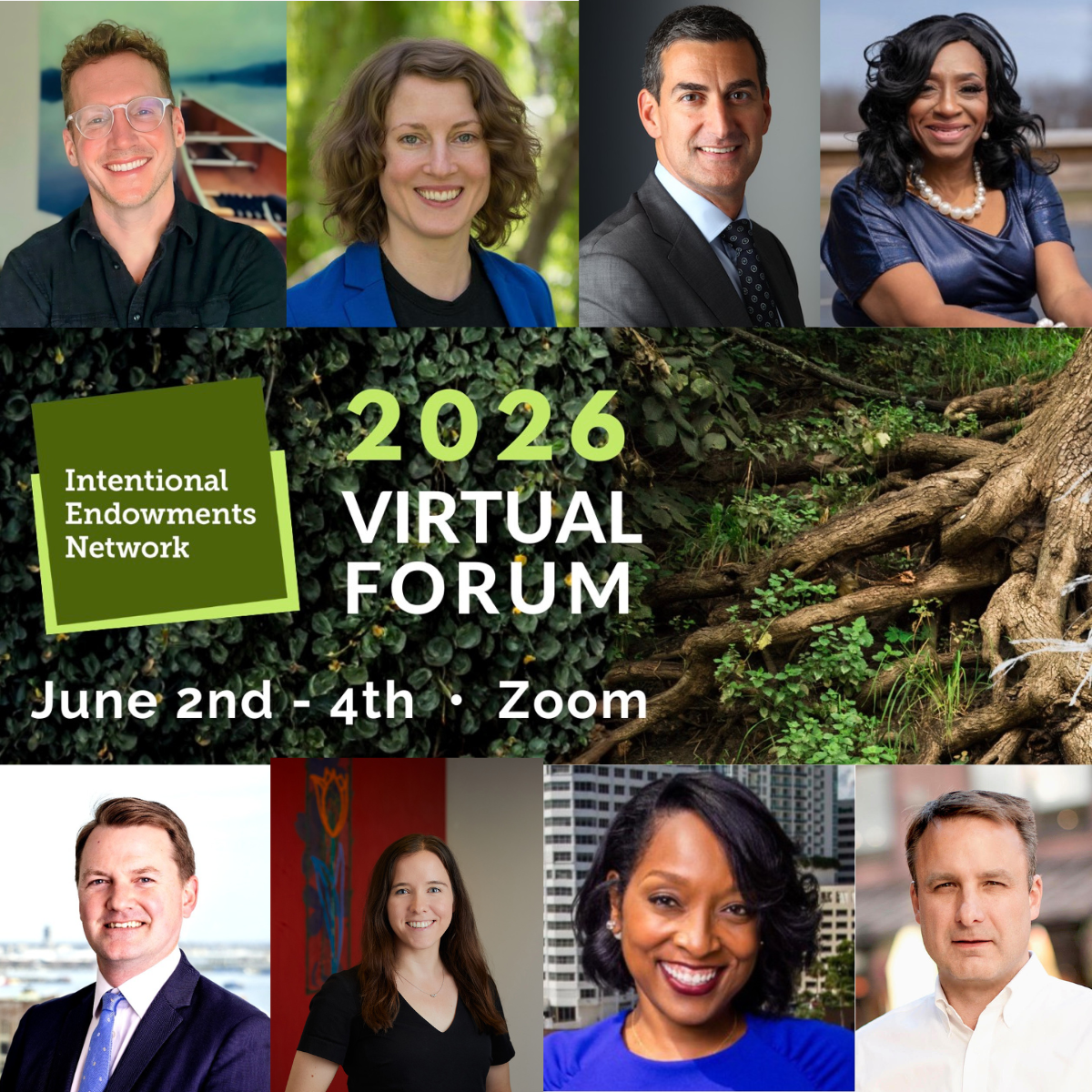
The 2026 IEN Virtual Forum brought together asset owners, investment professionals, legal scholars, and mission-driven institutions across three days of conversation, questions, and shared learning — tackling key themes such as the clean energy transition, responsible AI investing, holistic fiduciary duty, systems-level investing and justice-centered investing.
Systems, Science, and the Legal Case for Holistic Fiduciary Duty
Day 1 started with Bill Burckhart (TIIP) and Jon Lukomnik (Sinclair Capital) in a discussion about the recent release of The Handbook of System-Level Investing, which provides a guide to asset owners and portfolio managers navigating systemic risks. The case studies provide examples of asset owners engaging policymakers, restructuring portfolios to meet sustainable goals, and conceptualizing fiduciary risk.
In the second panel, a Case Study on Climate Justice Across the Portfolio, Valerie Boucard (Nathan Cummings Foundation) and Brigette Lumpkins (Bivium Westfuller) explored the methodological challenges of measuring impact beyond financial returns and introduced the AMOS Framework (Avoiding Harm, Mitigating, Optimizing, and Solution) as a tool for categorizing investments and assessing their real-world effects.
The Legal Case for Holistic Fiduciary Duty panel with Keith Johnson (GICS) and Susan Gary (University of Oregon School of Law) made the case that addressing climate risk and climate justice is actually a central part of one's fiduciary duty, although often overlooked today.
The day ended with a call to reintegrate science into sustainable finance from Jon Foley (Project Drawdown). He gave insights into the TLC framework (time, location, co-benefits) and rienforced that the solutions to combating climate already exist — we just have to use them at scale.
New Instruments, Climate Solutions, and the Pro-Human AI Stack
Day 2 expanded the Forum's lens to include new financial instruments, climate solutions, emerging investment opportunities in AI, and the long-term importance of building a more inclusive and sustainable finance industry. The first panel, University of Cambridge — Seeding a Fossil Free Cash Fund, included speakers Ellen Quigley (Cambridge University) and Mike Pearce (Managing Director, Cambridge Associates), highlighting the early successes of the recent Fossil Free Cash fund creation across a coalition of UK higher education institutions.
Later, the Forum brought together Scott Hobart (Mercator), Drake Hicks (Variant), Sara Murphy (SCF), Anil Tammineedi (Angeleno Group), and Mike Azlen (Carbon Cap) on the topic of climate solutions and current investment opportunities across carbon and power markets.
The following panel discussed Investing in the Alternative, Pro-Human AI Stack, where panelists Paul Fehlinger (Project Liberty) and Mark Surman (Mozilla Foundation) reframed AI not as a portfolio risk to manage, but rather a generational investment opportunity.
Day 2 also included an interactive workshop led by Katherine Markova in Climate Modeling with En-ROADS, giving participants a hands-on look at the climate simulator co-developed with MIT Sloan, which can be used to explore how population growth, rising incomes, and consumption patterns interact with climate trajectories.
The day ended with a keynote panel, Transforming the Face of Finance, featuring iDAC Foundation Chair of the Board of Directors, Purvi Gandhi, who described iDAC's theory of change for building a more inclusive alternatives industry from the ground up.
Structural Change, Collective Action, and Harnessing Power
Day 3 turned toward the structural and relational dimensions of systems-level investing — how to work with consultants, what the U.S. can learn from Canada, the power of collective action, and how to reckon with AI's social costs. The first panel, Coordinating Consultants for System-Level Progress, featured Max Messervy (Oakledge Advisors), Lisa Sebesta (Prime Buchholz), and Daniel Ingram (Aon), offering practical guidance for asset owners seeking to maximize the value of their consultant relationships and outlining key questions to ask when evaluating any consultant.
Next, leaders in Canada's Sustainable Investing industry — Kevin Thomas (SHARE), Wren Laing (McConnell Foundation), and Giancarlo Buonamici (McGill University) — highlighted meaningful differences in how Canadian institutions approach sustainable investing and what U.S. investors can learn from them. Notably, Wren Laing offered insight into a model with a 100% impact-aligned portfolio across all asset classes, with impact treated as an institutional asset class in its own right.
A Visionary Voices panel brought together Meredith Benton (Whistlestop), Oliver Nixon (Reframe Ventures), Jacob Tate (The GIIN), Steven Rothstien (Ceres), and Divya Sundar (Majority Action) to address intersectional approaches to artificial intelligence. This conversation surfaced the growing tension between AI's technical momentum and its social stagnation, investors' unique positions to raise societal concerns with companies, and the injustices caused by data centers being built across the country in already vulnerable communities.
The Forum closed on an empowering note from Renaye Manley during her keynote on Harnessing Power for System-Level Change. Manley — organizer of worker capital, pension fund advisor, and forceful advocate for justice in finance — challenged the room to ask not only what investments are making, but what they are doing in the world. She argued that compliance with existing rules is no longer sufficient, and encouraged asset owners and managers to ask the hard questions out loud, pick a singular mission, pursue it alongside others in a collective, and use networks like IEN as structures for mobilizing power.
Over the course of three days, this year's Forum made clear that the tools for transformation already exist and that we must continue working to deploy them at scale, to rethink the way we understand the foundations of fiduciary duty, and to confront the systemic risks posed by AI infrastructure and climate change.
IEN Members can access the recordings of the sessions on our 2026 Virtual Forum recordings page. Attendees can access recordings in the Airmeet event page through their registration link. We'll look to continue these conversations at our upcoming 2026 Annual Forum, November 18–20, 2026 at the University of Toronto, Toronto, ON. To learn more about the Annual Forum and stay updated with IEN, please follow this link and subscribe to our newsletter!