
The 2025 Intentional Endowments Network (IEN) Virtual Forum convened thought leaders, investment professionals, and mission-driven institutions over four dynamic days to explore how endowments and asset owners can advance systemic solutions through investment.
From addressing climate risk and democratic backsliding to transforming stewardship and redefining fiduciary duty, the Forum showcased practical frameworks and forward-looking strategies to meet the moment.
Day 1 opened with keynote addresses from Jon Lukomnik and Mike Kubzansky, followed by a panel led by Chris Jurgens. Lukomnik challenged the Modern Portfolio Theory’s neglect of systemic risk, emphasizing system-level investing—where 75–94% of returns are tied to market-wide factors.
Kubzansky, CEO of Omidyar Network, highlighted the risks of unchecked AI growth, advocating for responsible governance and regulation. In the closing panel, Jurgens and colleagues Ananya Mukherjee, Hilary Irby, and Lauren Compere outlined how asset owners can shape ethical AI by assessing risk, improving governance, and ensuring evolving oversight.
Day 2 tackled political risk, equity in asset management, and carbon markets. Philippe Bolopion warned of rising autocracy and its threat to economic growth, while Lauren Caplan urged investors to strengthen due diligence.
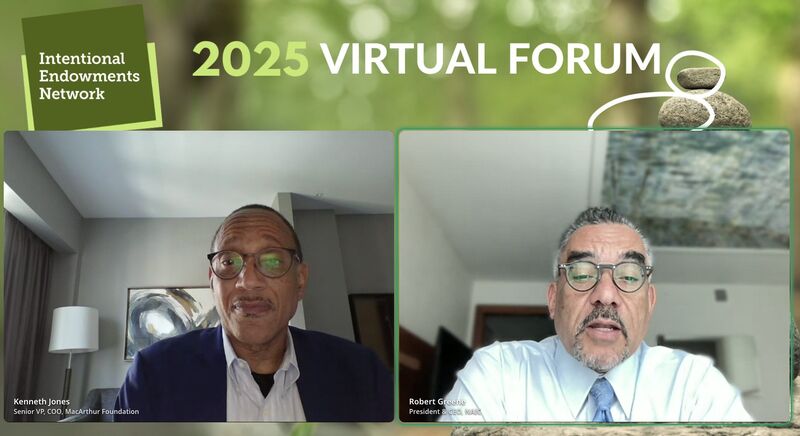 Robert Greene of the NAIC and Kenneth Jones of the MacArthur Foundation (pictured left) addressed systemic barriers to diverse managers and introduced NAIC’s “4P” framework. Mike Azlen closed with a compelling case for Emissions Trading Systems (ETS)—policies that have already reduced carbon emissions by 31% and created a growing, high-performing $200 billion market.
Day 3 featured a keynote from David Livingston, who identified three global clean-energy transitions: the decline of G7 dominance, the shift from climate cooperation to competition, and the rise of electricity and data over oil and gas. A Visionary Voices panel followed, where speakers like Heather Smith and Jaylen Spann examined the role of shareholder rights and data in shaping just outcomes.
Kathryn Hopkins called for climate-aligned retirement strategies, and Julianne Zimmerman challenged the investment community to act boldly in the face of systemic risks. The day concluded with a panel on the Endowment Impact Benchmark (EIB), where Emily Philpott and Alexandra Chamberlain showcased a framework for improving sustainable investment practices through transparency, governance, and internal alignment.
Day 4 wrapped the Forum with a focus on board diversity, climate-aligned fiduciary responsibility, and systemic stewardship. Julie Zuraw introduced a new toolkit to depolarize and strengthen conversations about board diversity.
In a panel moderated by Kirsten Spalding, John Adler described how NYC pension funds are requiring asset managers to adopt decarbonization plans by 2025, while Machal Allen noted that climate strategies must still meet return benchmarks. Finally, Sara Murphy of The Shareholder Commons called for a new era of stewardship—one that prioritizes portfolio-wide and systemic health over individual company profits and confronts the negative externalities of short-termism.
The 2025 Virtual Forum underscored the critical role institutional investors play in shaping a resilient, just, and sustainable future. As systemic risks grow and societal expectations shift, the IEN community continues to lead by example—advancing investment practices that align fiduciary duty with real-world outcomes.
IEN Members can access the recordings of the sessions on our 2025 Virtual Forum recordings page. Attendees can access recordings in the Airmeet event page through their registration link.
We'll look to continue these conversations at our upcoming 2025 Annual Forum, October 27-28, 2025 at Goucher College in Baltimore, Maryland. Learn more about the Annual Forum, and keep an eye out for registration details.